
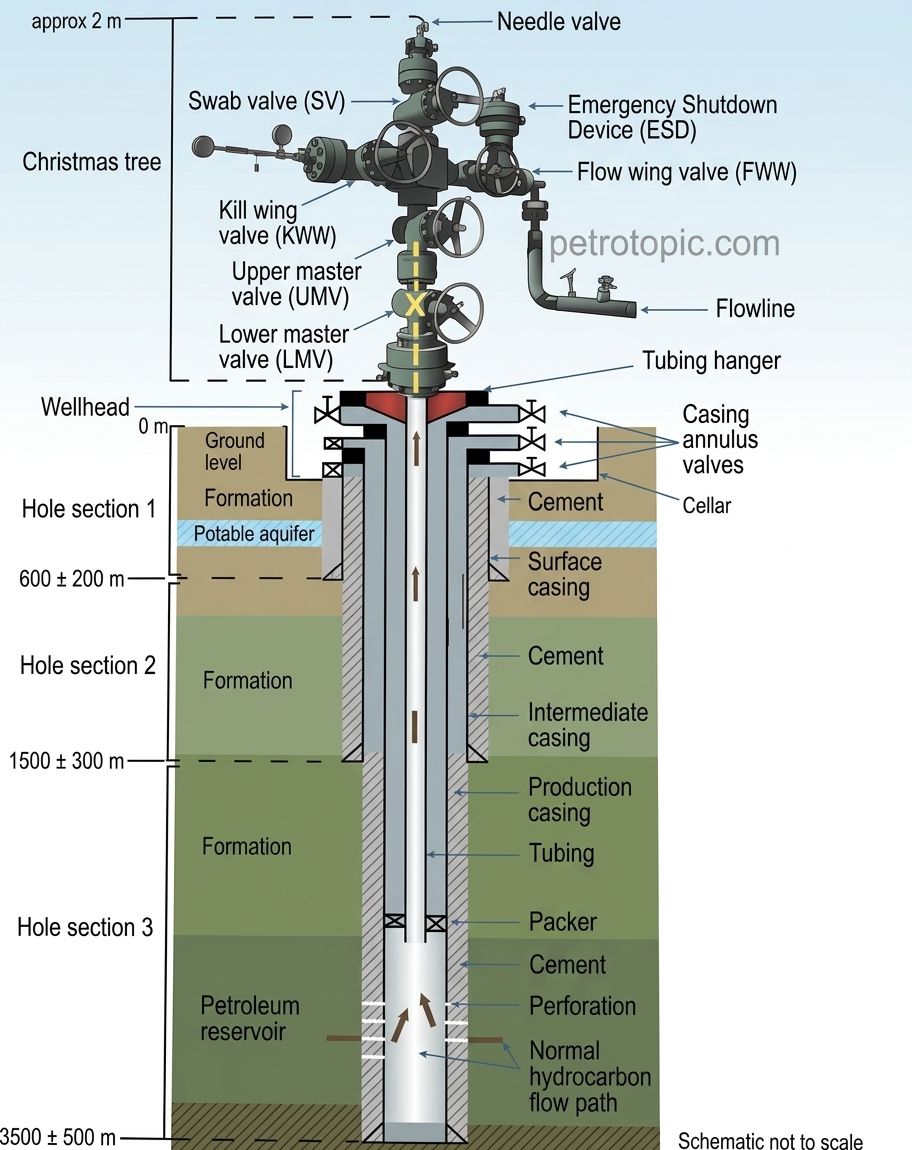
Static Fluid Level and Shut-In Tubing Head Pressure Calculation
Introduction
The static fluid level inside a well can be estimated from reservoir pressure, shut-in tubing head pressure (SITHP), gas pressure gradient, fluid pressure gradient, and well depth.
This calculation is useful when evaluating a shut-in well and estimating the position of the gas-liquid interface inside the wellbore.
The fundamental pressure relationship is:
Pr = SITHP + Pgas + Pfluid
where:
- Pr = reservoir pressure
- SITHP = shut-in tubing head pressure
- Pgas = pressure contribution from the gas column
- Pfluid = pressure contribution from the liquid column
Basic Wellbore Pressure Model
Consider a well with total vertical depth D and a static fluid level at depth L.
The gas column extends from the surface to the static fluid level:
Gas column = L
The fluid column extends from the static fluid level to the well depth:
Fluid column = D − L
If the gas pressure gradient is Gg and the fluid pressure gradient is Gf, the corresponding pressure contributions are:
Pgas = Gg × L
Pfluid = Gf × (D − L)
Therefore:
Pr = SITHP + Gg × L + Gf × (D − L)
This is the fundamental equation used by the Petrotopic calculator.
Calculating Static Fluid Level
If reservoir pressure and SITHP are known, the static fluid level can be calculated.
Starting with:
Pr = SITHP + Gg × L + Gf × (D − L)
Expanding the equation:
Pr = SITHP + GgL + GfD − GfL
Rearranging:
Pr − SITHP − GfD = L(Gg − Gf)
Therefore:
L = (Pr − SITHP − GfD) / (Gg − Gf)
where:
- L = static fluid level depth
- Pr = reservoir pressure
- SITHP = shut-in tubing head pressure
- Gg = gas pressure gradient
- Gf = fluid pressure gradient
- D = well depth
The fluid column can then be calculated from:
Fluid Column = D − L
Calculating SITHP
The calculation can also be reversed.
If the static fluid level is known from an independent measurement, SITHP can be estimated.
Starting with:
Pr = SITHP + GgL + Gf(D − L)
Rearranging for SITHP:
SITHP = Pr − GgL − Gf(D − L)
The Petrotopic calculator therefore provides two calculation modes:
| Mode | Known Data | Calculated Result |
|---|---|---|
| Calculate Fluid Level | Reservoir pressure + SITHP + pressure gradients + well depth | Static fluid level + fluid column |
| Calculate SITHP | Reservoir pressure + measured fluid level + pressure gradients + well depth | Estimated SITHP + pressure contributions |
Example Calculation
Consider the following example:
| Parameter | Value | Unit |
|---|---|---|
| Reservoir Pressure | 5,000 | psig |
| SITHP | 3,200 | psig |
| Gas Gradient | 0.015 | psig/ft |
| Fluid Gradient | 0.433 | psig/ft |
| Well Depth | 12,000 | ft |
The static fluid level is:
L = (5,000 − 3,200 − 0.433 × 12,000) / (0.015 − 0.433)
The calculated value can then be compared with the physical well depth.
The fluid column is:
Fluid Column = 12,000 − L
An Important Engineering Limitation
A very important point is that reservoir pressure alone is not sufficient to determine both SITHP and static fluid level.
The governing equation contains two unknowns:
Pr = SITHP + GgL + Gf(D − L)
If both SITHP and L are unknown, there are not enough independent measurements to solve the equation uniquely.
An independent measurement is therefore required.
Possible independent measurements include:
- Stabilized shut-in tubing head pressure measurement
- Measured static fluid level
- Downhole pressure measurement
- Other independent pressure or wellbore measurements
For practical field application, a properly stabilized SITHP measurement can be used as the input to calculate the static fluid level.
Alternatively, if the fluid level has been independently measured, the corresponding SITHP can be estimated.
Why SITHP Should Preferably Be Measured
SITHP should preferably be obtained from an actual shut-in pressure measurement rather than simply assumed.
After the well is shut in, the tubing-head pressure changes as the wellbore approaches a static condition. The pressure should therefore be monitored until the selected stabilization criterion is reached.
The measured stabilized pressure can then be used as SITHP in the static fluid-level calculation.
This approach avoids introducing an arbitrary SITHP value into the calculation.
Gas Gradient Consideration
The simple calculation above assumes a constant gas pressure gradient.
This is a useful engineering approximation for screening calculations, but gas is compressible and its pressure gradient can vary with:
- Pressure
- Temperature
- Gas composition
- Gas compressibility factor
- Gas density
For deep gas wells, a pressure- and temperature-dependent gas-column calculation can provide a more rigorous pressure profile than using a single constant gas gradient.
Therefore, the constant-gradient method should be understood as a simplified wellbore pressure model.
Practical Workflow
A practical workflow is:
| Step | Action |
|---|---|
| 1 | Shut in the well and monitor tubing-head pressure. |
| 2 | Determine an appropriate stabilized SITHP. |
| 3 | Obtain reservoir pressure from the appropriate reservoir-pressure source. |
| 4 | Determine the gas and liquid pressure gradients. |
| 5 | Enter the well/reservoir TVD. |
| 6 | Calculate the static fluid level. |
| 7 | Compare the calculated fluid level with any available field measurement. |
Petrotopic Static Fluid Level / SITHP Calculator
The Petrotopic calculator provides two modes:
Calculate Fluid Level
Uses measured or selected SITHP to estimate the static fluid level.
Calculate SITHP
Uses an independently known static fluid level to estimate the corresponding SITHP.
The calculator also displays the individual gas-column and fluid-column pressure contributions when calculating SITHP.
This provides a simple way to perform a pressure-balance check for a shut-in well.
Conclusion
The static fluid level can be calculated from the pressure balance:
Pr = SITHP + GgL + Gf(D − L)
For a known SITHP:
L = (Pr − SITHP − GfD) / (Gg − Gf)
For a known static fluid level:
SITHP = Pr − GgL − Gf(D − L)
The most important practical consideration is that SITHP and fluid level cannot both be independently calculated from reservoir pressure alone. At least one additional independent measurement is required.
For field applications, measured and sufficiently stabilized SITHP or an independent fluid-level measurement should therefore be preferred over an assumed value.